
Reclaiming The Meaning Of Commissioning
By Louis Charlton, CEO
A perspective on why commissioning must return to its roots: certification, verification, and proof.

For years, commissioning has been treated as something to manage.
Schedules, documents, sign-offs, and spreadsheets.
But commissioning was never meant to be an administrative function. It was meant to be a certification of performance.
Over the last decade, as data centres have scaled faster than ever before, the meaning of commissioning has become blurred. Today, almost anyone can claim to “offer commissioning management.” Yet few are willing, or able, to certify that a facility truly performs as designed.
At Global Commissioning, this distinction is fundamental to who we are.
We don’t oversee commissioning. We certify performance.
In this article, I want to explain why that difference matters - not just for our business, but for the future reliability, efficiency, and integrity of the data centre industry as a whole.
Commissioning Is About Certification and Verification, Not Just Management
Over the past decade, the language of commissioning has changed dramatically.
What was once a clearly defined discipline, technical, structured, and evidence-based, has become increasingly diluted.
Today, almost every contractor or consultant seems to “offer commissioning management” as part of their service line. The phrase has become a fixture on capability statements, often sitting neatly between “design management” and “handover support,” as if commissioning were simply another administrative process within a project lifecycle.
But commissioning is not something you offer; it is something you certify. And that distinction matters more than ever.
In a world where uptime, energy efficiency, and operational reliability are fundamental to client success, the way our industry defines commissioning carries real consequences.
When the meaning of commissioning becomes blurred, so too does the standard of assurance that clients expect and depend on.
The Erosion of Meaning
Commissioning has always been about assurance: proving that what was designed, built, and integrated actually performs as intended.
Yet, as the data centre sector has expanded at extraordinary speed, the term has broadened to cover a vast range of interpretations.
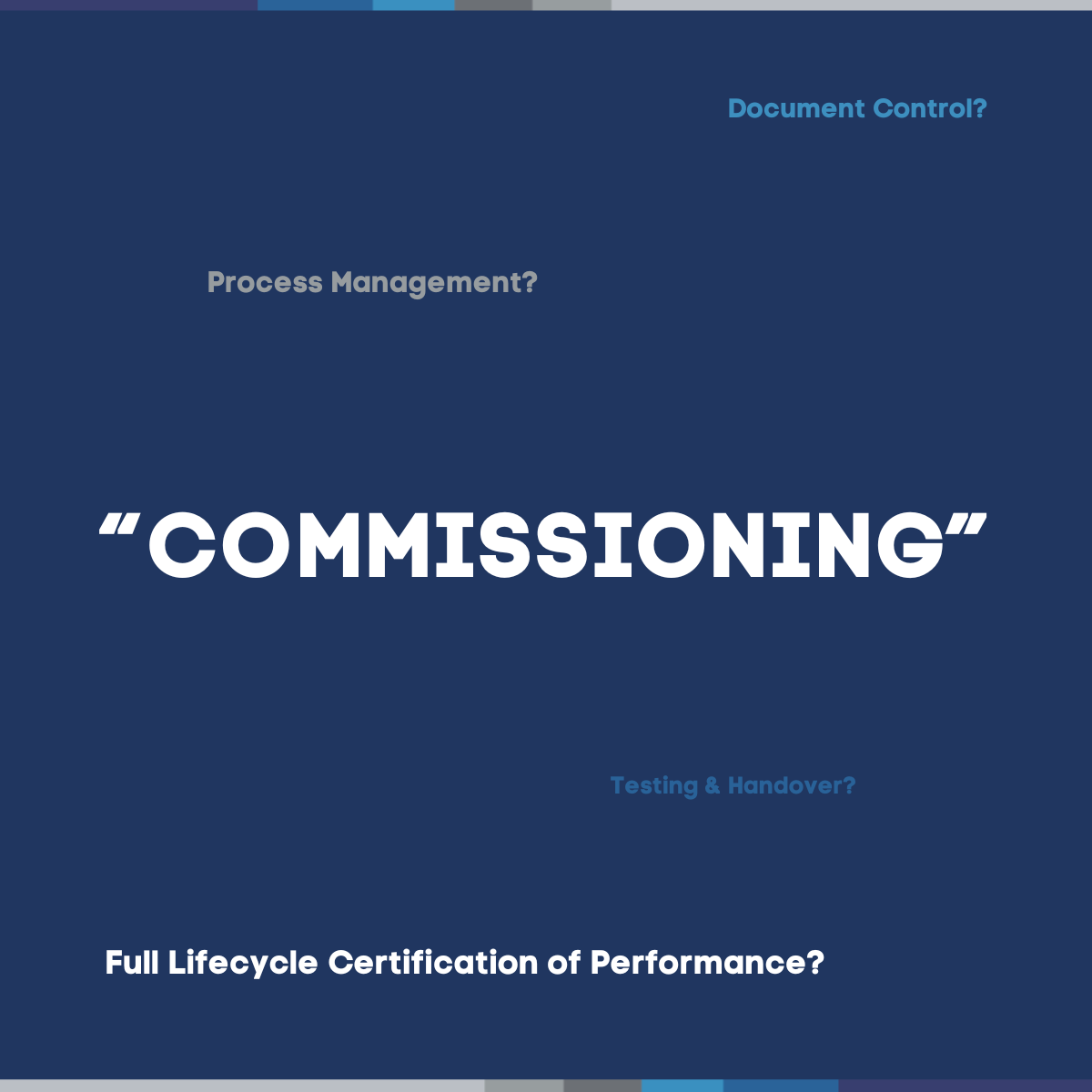
Some see commissioning as document control or process management; others use it to describe testing and handover; and a few, still, understand it as a full lifecycle certification of performance.
This broadening of definition has, unintentionally, diluted the credibility of commissioning as a discipline.
Clients hear the same word from multiple providers but rarely receive the same level of technical depth, independence, or rigour. The result is confusion and, in some cases, misplaced trust.
Too often, we see commissioning managers parachuted in near the end of a project, handed a collection of spreadsheets, checklists, and reports, and tasked with “closing out” commissioning.
It is an approach designed for completion, not for verification. It may achieve sign-off, but it does not deliver proof.
True commissioning cannot be bolted onto the end of a programme or managed from a desktop. It requires technical engagement, continuity, and structure from the earliest design stage through to performance testing. In short, it must be built in, not applied retrospectively.
Certification: The True Outcome of Commissioning
At its heart, commissioning is a certification process, one that provides measurable, defensible evidence that a facility performs exactly as designed. It is the final assurance layer between construction and operation, the point at which assumptions are tested and verified against real performance.
When commissioning is carried out properly, the result is not simply a completed handover file but a certified statement of reliability and readiness. Every sequence, every interface, and every system is demonstrated to function safely, efficiently, and in harmony with the others.
This is the foundation on which we have built Global Commissioning.
Our role is not to oversee commissioning, but to certify performance. We validate that design intent has been achieved, that all performance standards are met, and that the asset operates in full accordance with its engineered purpose.
Our certification is not theoretical. It is recognised across EMEA by some of the world’s largest owner-operators and
end-user organisations for whom downtime is not an inconvenience but an existential risk. To them, commissioning is not paperwork; it is protection.

Verification: The Missing Discipline
Verification is the cornerstone of genuine commissioning, and yet it is often the first element lost when the process is treated as an add-on service.
It is verification that transforms commissioning from coordination into proof.
This is where technical expertise and independence matter most.
Verification is not an administrative exercise; it is the practical observation and testing of systems under load.
It is validating the sequence of operations, confirming redundancy, assessing control logic, and ensuring interoperability between disciplines.
It demands engineers who understand not just how systems function individually, but how they behave collectively and how those relationships impact overall performance.
Behind every certification issued by Global Commissioning are professionals who have lived through these processes countless times.
They have witnessed systems under real operating conditions, challenged assumptions, and resolved conflicts long before a client ever steps into the facility.
Their work provides not only confidence but traceability, a data-backed assurance that the design intent has been realised.
Verification is not glamorous work, but it is essential.
Without it, commissioning becomes opinion rather than evidence.
Why This Matters Now
The data centre sector is entering a new era. The rise of AI, the demand for high-density computing, and the global focus on sustainability are transforming the technical landscape at a pace the industry has never seen before. Systems are becoming more complex, interdependent, and software-driven. Timelines are becoming tighter. Risk tolerance is shrinking.
In this environment, the role of commissioning has never been more critical, nor more misunderstood. As project pressures grow, there is a temptation to compress or simplify commissioning to keep up with delivery schedules. But doing so undermines the very outcome it is meant to protect: reliability.
Proper commissioning, certification, and verification are not a luxury. It is the mechanism that ensures design intent survives contact with reality. It is the process that safeguards operational performance long after construction has finished.
The Role and Responsibility of Global Commissioning
At Global Commissioning, commissioning is not a service we added; it is the reason we exist. Every process, every tool, and every training programme we develop is designed around one purpose: to certify performance.
Yes, our name includes the word “commissioning,” but what we actually deliver is validation. We validate that what was designed and constructed performs exactly as intended, and we certify that result through a disciplined, transparent, and repeatable methodology. That clarity of purpose is what gives our certification its strength and consistency.
We view commissioning as the final quality gate, the point where documentation ends and evidence begins. It is the interface between project delivery and operational excellence. And in that moment, independence and integrity are everything.
Reclaiming the Meaning of Commissioning
Commissioning should never be reduced to another service line. It is the industry’s most important form of assurance, the certification that design intent has been achieved, and that the facility performs as engineered.
At Global, we are proud to carry the name commissioning, because to us it still means what it always should have: validation, verification, and proof. It represents not a process to be managed, but a standard to be upheld.
As our industry continues to evolve, we all have a choice to make. We can treat commissioning as another box to tick, or we can protect it as the certification discipline that underpins performance, safety, and reliability across the data centre world.
Commissioning is more than management. It is validation. It is a certification. It is verification.
And when it is done properly, it is the difference between a project that reaches completion and one that truly performs.